


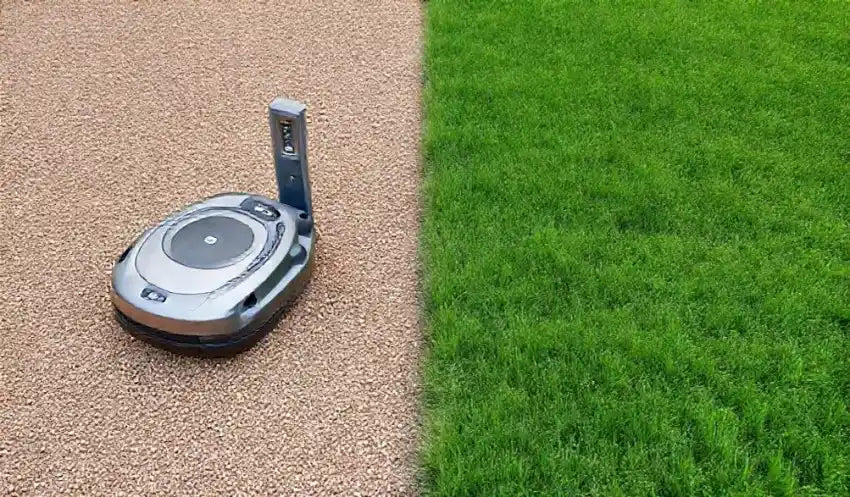
When placing a robotic lawnmower, the positioning of the charging station must be carefully considered. While it is generally recommended to place the charging station within the lawn area, some users prefer to place it outside the lawn due to space constraints or aesthetic reasons. So, is it possible to place the charging station for a robotic lawnmower outside the lawn? If so, how should this be done?
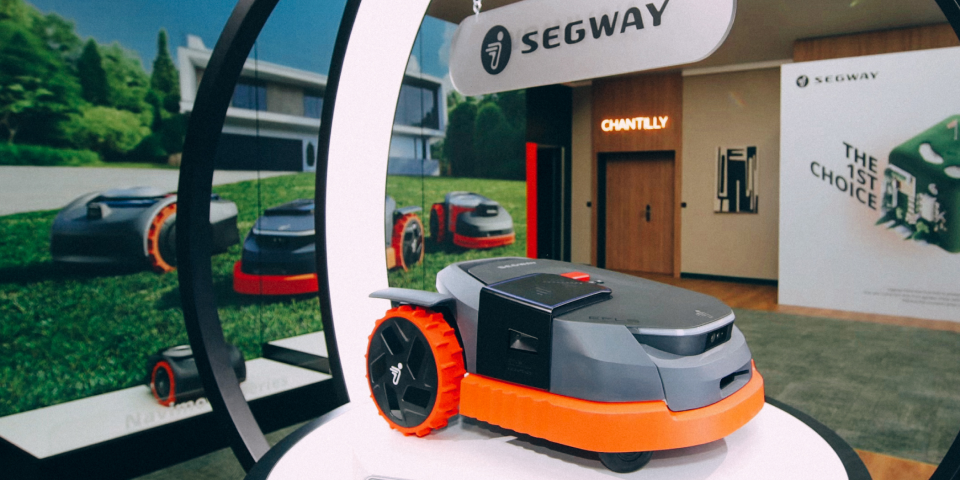
This article provides detailed answers and step-by-step instructions. Finally, we would like to introduce you to the Segway Navimow robotic lawnmower. The charging station for this mower requires no cables and can easily be placed outside your lawn area.
Contents
- Can the charging station for the robotic lawnmower be placed outside the lawn?
- What is the problem with placing the charging station outside the lawn?
- Improved solution for installing charging stations for robotic lawnmowers outside the lawn
- Place wireless charging stations for robotic lawnmowers outside the lawn.
- Conclusion
- FAQs about placing charging stations for robotic lawnmowers outside the lawn
Can the charging station for the robotic lawnmower be placed outside the lawn?
In short, it is generally not advisable to place the charging station for your robotic lawnmower outside the lawn area. Most manuals for robotic lawnmowers on the market generally advise against placing the charging station outside the lawn.
The reason for this is that robotic lawnmowers operate on the principle of navigating and defining their working area along the boundary wires laid around the lawn. The charging station serves as the system's "zero point" or "home." The vast majority of robotic lawnmowers on the market require this boundary line to find their way back to the base station.
If the charging station is located outside the lawn, the robot has to leave the boundary line system when returning from the lawn to the charging station. This contradicts its basic pathfinding logic. As a result, it may circle endlessly at the edge of the boundary line and be unable to find the charging station. You could extend the boundary line slightly to accommodate a charging station or create a separate path so the robotic mower can return to its charging station along the boundary. However, this approach can also present some problems. I will explain these in detail below.
What is the problem with placing the charging station outside the lawn?
Generally, there are two methods for extending the boundary lines for building a charging station outside the lawn. One method involves creating a ledge along the boundary line, leaving only the space required for the charging station. The other method involves creating a special corridor through which the robotic lawnmower can return to the charging station.
Scenario 1. Only the area required for the charging station is retained.
If you only reserve a space for the charging station, this can lead to the robotic lawnmower becoming confused upon its return or the signal being disrupted.
The reason for this lies in the way the robotic lawnmower works, as it relies on a so-called "short-range signal" to automatically dock at the charging station. This signal is emitted by an antenna on the charging station's circuit board and helps the robotic lawnmower determine its position.
Once the robotic lawnmower reaches the charging station's boundary wire, it uses the short-range signal to correct its orientation before entering the station. However, if the space for the charging station is so small that the boundary wires are too close together, the robotic lawnmower may misinterpret the signal. In this case, it could have difficulty correctly approaching the charging station and returning automatically.

Scenario 2. Set up a special passage
Even if you leave extra space when setting up the boundary line, or even create a special passage so the robotic lawnmower can leave the lawn and return to its charging station outside the lawn, problems can still occur. This is because most robotic lawnmowers, by default, consider the area within the boundary line as their working area. As long as they remain within this line, they will continue mowing continuously.
However, if the robotic lawnmower leaves the lawn and continues driving while its blades are idling, it can easily be damaged on uneven surfaces or loose gravel. Another potential problem is that a passage that is too narrow can prevent the robotic lawnmower from recognizing it as a corridor, causing it to get stuck. In other cases, it may constantly collide with the boundary lines on both sides of the passage. This prolongs its operating time and leads to unnecessary energy consumption.

Improved solution for installing charging stations for robotic lawnmowers outside the lawn
Option 1. Funnel-shaped design
If you want to place the charging station at the edge of the lawn, for example next to a patio or flower bed, this solution is ideal. It's important that the boundary lines on both sides of the charging station run diagonally outwards. This creates a funnel-shaped channel that prevents the robotic lawnmower from getting stuck on the angled corners of the boundary – for example, in flower beds. To further improve guidance, you can place lawn edging stones at the corners.

Although this technology was originally developed for a Husqvarna Automower, it can easily be applied to Gardena robotic lawnmowers as well. This solution allows you to place the charging station outside the lawn – for both Husqvarna and Gardena models.
For robotic lawnmowers that enter the charging station from the side (like some Worx models), a special, wide funnel design is required. It is particularly important to keep a straight section of 50 to 70 cm (up to one meter on slopes) clear at the entrance so the device can easily reverse. The exit side should be designed as a 45-degree curve to guide the robotic lawnmower efficiently into the working area, as it turns left immediately upon starting.

Option 2. Corridor design
If your robotic lawnmower can return to the charging station by following a guide wire, you can create a longer passage. However, this feature is only available for robotic lawnmowers that enter the charging station from the front. When creating the passages, ensure that the required minimum distance for your model is maintained and that the guide wire always remains a sufficient distance from the boundary wire.
To prevent the wire from bending prematurely, it should only curve inwards approximately halfway along the path to the charging station. Additionally, two circular guide wires can be placed at the entrance, forming a funnel-shaped area. This reduces the likelihood of the robotic lawnmower entering this area if it fails to return to the charging station.
Place wireless charging stations for robotic lawnmowers outside the lawn.
If laying boundary and guide wires is too complicated for you, or you simply don't want cables on the ground, then a robotic lawnmower without boundary wires is the perfect solution. These mowers navigate using GPS and an internal map. This allows the charging station to be placed anywhere.
Segway's Navimow i-series, for example, uses a revolutionary technology for centimeter-accurate positioning and zone mapping. This completely eliminates the cumbersome placement of boundary wires.
Let's take the Segway Navimow i105 robotic lawnmower as an example. With this model, you can easily define mowing zones and no-go areas via a mobile app. This means you can place the charging station anywhere on level ground outside the lawn, for example, on the patio, in the garage, or in a corner, provided the robot can reach it without obstacles. Furthermore, you don't have to spend hours laying and securing boundary wires. This significantly simplifies installation. You'll never again have to look at unsightly cables or ground stakes in your garden.

Conclusion
In short, placing a robotic lawnmower's charging station outside the lawn is generally not recommended, as this can impair the robot's navigation. Robotic lawnmowers typically use boundary wires to define their working area and guide them back to the charging station. If the charging station is placed outside the lawn, the robot may not be able to find its way back, leading to malfunctions. However, there are solutions, such as creating a special passage or using a funnel design, that allow the robot to return to the charging station. Another option is robotic lawnmowers without boundary wires, such as the Segway Navimow i-series, which offer simpler and more flexible installation. Ultimately, the best solution depends on the specific circumstances and the model of robotic lawnmower.
FAQs about placing charging stations for robotic lawnmowers outside the lawn
How can I best protect my robotic lawnmower from damage if I place the charging station outside the lawn?
If the charging station is placed outside the lawn, the robotic lawnmower may encounter uneven surfaces such as gravel or hard surfaces. To avoid this, ensure the path to the charging station is well-maintained and smooth. Use paving stones or gravel to stabilize the area. Also, ensure the robotic lawnmower operates on firm ground to protect the blades and other sensitive parts.
Do I need to make any special adjustments to the boundary line when installing a charging station outside the lawn?
Yes, generally, if the robotic mower is placed outside the lawn, special adjustments to the boundary wire are necessary to ensure it returns correctly to its charging station. For example, a specially shaped corridor or a wider access point may be required to guide the robot safely to the charging station without it getting stuck or losing signal. Also, make sure the boundary wire is a sufficient distance from the charging station and that there are no sharp bends.

Jaa: