


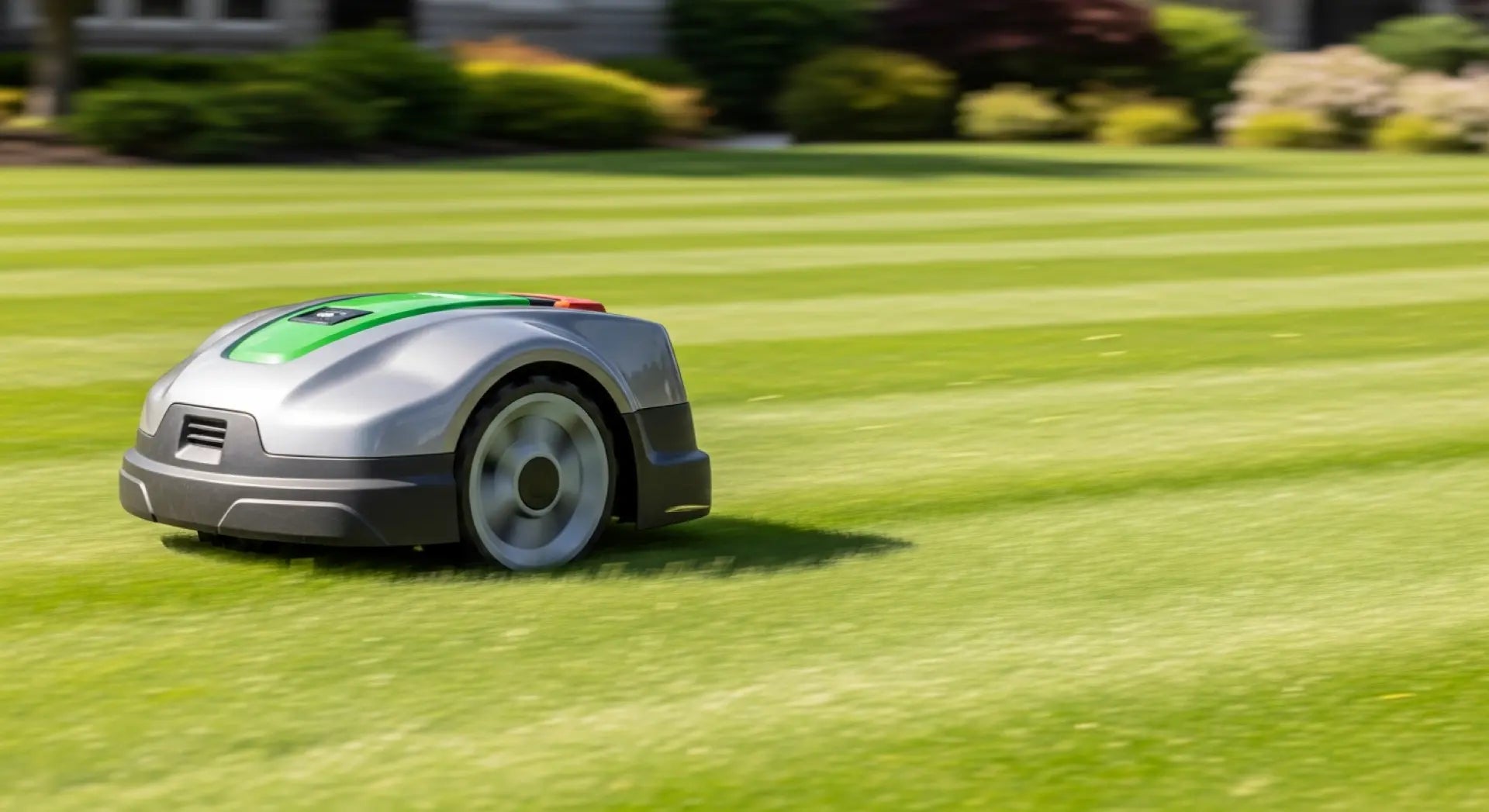
How long does a robotic lawnmower take to mow 200 square meters? Stop staring at the square meter figure on the packaging. That's often purely theoretical for a perfect, square golf course lawn without a single tree. But your garden isn't theoretical.
In this article, I'll break down exactly which factors influence mowing time, how to measure your device's actual performance, and how to calculate the true mowing time for 200 square meters step by step. At the end, I'll also show you a few robotic lawnmowers that are particularly well-suited for 200 square meters, so stay tuned.

Contents
Technical features that determine the mowing speed
Not all robotic lawnmowers are created equal. The technology determines whether it works quickly or slowly. For a 200 sq m lawn, a closer look is worthwhile, because only those who understand the key factors can realistically estimate how long a robotic lawnmower will need for that area. The following points are particularly crucial:
- **Cutting Height**: The height to which the grass is cut significantly affects mowing time. A moderate setting between 3 and 5 cm is optimal for 200 m². Lower cutting heights require more frequent cuts and therefore extend the mowing time.
- **Cutting width**: It's pure math. A mower with a 40 cm cutting width will logically finish faster than one with 18 cm. For 200 m², a width between 18 and 22 cm is common and perfectly adequate.
- **Number of Blades**: More blades mean less overlap in practice, resulting in shorter mowing times. Three rotating blades are standard today and offer the best compromise between speed and cutting quality. A three-blade model is ideal for 200 m²; it works cleanly and evenly, and saves noticeable time compared to single-blade systems.
- **Battery performance**: A powerful battery means longer mowing cycles and fewer breaks at the charging station. A good mower for this garden size should be able to mow for at least 60 minutes continuously before needing to recharge for a similar amount of time.
- **Navigation**: Most robotic mowers operate on a random pattern, a so-called "chaotic" mowing method. While this works, it's not particularly efficient. Newer, higher-quality models navigate systematically in straight lines, drastically reducing mowing time.

Furthermore, features like object detection in high-quality robotic lawnmowers and their ability to cope with bad weather also noticeably influence the mowing speed. Of course, all of this also depends heavily on the growing climate and the conditions in your garden.
Factors in your garden that slow down the mower
Your garden is the real boss. It dictates the actual mowing time. How long a robotic lawnmower needs for 200 square meters depends not only on the size of the area, but above all on the specific conditions of your property:
- **Complexity**: Every tree, flowerbed, bush, and narrow passage is an obstacle the robotic lawnmower must navigate around. The more intricate the garden, the longer the mowing takes. Speaking of which, different terrain also places different demands on the drive system. On flat, level ground, front-wheel drive with average engine power is usually sufficient. For more challenging terrain, however, rear-wheel or all-wheel drive is essential.
- **Slopes**: Do you have a slope in your garden? This costs the mower power and battery power. The area coverage specified by the manufacturer almost always refers to flat terrain. Many manufacturers specify a maximum slope capacity at the 10% limit. This means that while the robot will still work on steeper slopes over 10%, the mowing speed and efficiency will decrease significantly.
- **Number of Zones**: Do you have a separate lawn area in front of your house? The robot first has to find its way there, which reduces overall efficiency. However, if your robotic lawnmower has AI-powered mapping and autonomous scheduling of mowing times, it can optimally manage the areas and significantly increase mowing performance.
- **Lawn Conditions**: Tall, dense, or wet grass is like a steep climb for the mower. It has to work more slowly to achieve a clean cut. While there are no precise measurements of how much this slows the mower down, one thing is certain: the more powerful the robotic mower, the less it will experience this effect.

How do you calculate the mowing time for 200 m²?
So far, we understand that the mowing speed of a robotic lawnmower depends not only on its hardware and software, but is also heavily influenced by external factors such as the terrain and the layout of the garden. The device's technical specifications provide a basis, but to estimate the actual mowing time, we need to consider further influencing factors, for example, an efficiency factor. With a little math, it's easy to calculate how long a robotic lawnmower will actually need to mow 200 square meters.
Here is a practical example:
Let's imagine your robotic lawnmower has a cutting width of 18 centimeters and travels at a maximum speed of 0.4 meters per second.
Let's do the math:
Therefore, the robot mows 0.18 m × 0.4 m = 0.072 square meters per second.
Extrapolated to one hour, that's 0.072 m² × 3600 seconds = 259.2 square meters per hour.
That sounds great at first, but in reality, that's never the value you'll get. Due to obstacles, curves, and charging breaks, we assume an efficiency of around 50 percent. So, effectively, the robot covers about 130 square meters per hour.
Therefore, you need at least 1.5 hours of pure mowing time for 200 square meters.
In addition, most robotic lawnmowers mow for about 60 minutes per battery charge and need around 90 minutes to recharge. So, you mow for an hour, then charge for 90 minutes, and mow for the remaining 30 minutes. In total, you can realistically expect it to take about 3 hours to completely cut the lawn. It's that simple, and once you understand this, you'll already be a pro at estimating how long your robot will need for your garden.
Which robotic lawnmower is suitable for 200 m²?
Now we know approximately how long a robotic lawnmower needs to mow 200 square meters and how to calculate that. But to ask it another way: How do I choose a robotic lawnmower that will mow my 200 square meter lawn particularly efficiently? This is where two fully automatic models from Segway Navomow come into play, which will do exactly that and meet your expectations.
Segway Navimow i105
If you want your robotic lawnmower to cover 200 square meters in 3 to 4 hours, the Segway Navimow i-series is undoubtedly the best choice in terms of value for money. The parameters used in our example calculation come directly from the Segway Navimow i105 model. With a cutting height of 20 to 60 millimeters, a cutting width of 18 centimeters, and three sharp, large blades, it guarantees a maximum mowing speed of 0.4 meters per second. Thanks to the improved EFLS 2.0 positioning technology with centimeter-level accuracy, as well as AI-supported mapping and VisionFence obstacle avoidance, the robot optimally handles different terrains. This ensures maximum mowing performance and efficiency, even in complex garden layouts. Additionally, the fast charging time of 90 minutes allows the Navimow i105 to effortlessly cover 200 square meters of lawn on a single charge. This makes it a reliable and powerful partner for your garden.

Segway Navimow H500-VF
If your lawn is uneven or consists mainly of tough meadow grass, a more powerful model is worthwhile. The Navimow H series with rear-wheel drive offers the right performance for this. Even the entry-level H500 VF model allows a cutting height of 30 to 60 millimeters and a cutting width of 21 centimeters. With a powerful battery that charges in 180 minutes and mows for the same amount of time, it can cover 200 square meters of lawn in one pass, ensuring an even and efficient result.
However, the H series comes at a price. Compared to the Segway Navimow i series, it is more expensive and has somewhat simpler software. It doesn't support 4G, still uses the older EFLS 1.0 positioning system, and lacks features like child safety locks. But for those who prioritize performance and are willing to invest a bit more, the Segway Navimow H500 VF is a robust, durable, and powerful robotic lawnmower that confidently handles even challenging lawn conditions.

The last word
Buy a mower designed for a slightly larger lawn than your area (e.g., a model for 300-500 m²). This gives you a buffer for complex areas and ensures the machine isn't constantly running at its limit. This way, you can enjoy a perfectly manicured lawn for a long time without lifting a finger.
If you've landed right here, you've come to the right place. Segway Navimow's smart robotic lawnmowers cover at least 500 square meters, offering plenty of options. Now you also know which factors influence mowing time and how to calculate how long a robotic lawnmower will need for 200 square meters. Why not visit the Segway Navimow website right away and find the model that perfectly suits your needs? Currently, you can take advantage of attractive price benefits.
FAQs
1. How long does a robotic lawnmower need for 200 square meters of lawn?
Under normal conditions, good models need between three and four hours to completely mow 200 square meters. This includes charging time. It's somewhat faster on very easy terrain, but can take significantly longer on slopes or with many obstacles.
2. Why does the robot take so long to cover such a small area?
A robotic lawnmower doesn't cut everything at once, but works on the mulching principle. It only cuts a few millimeters of the grass blades and covers the area regularly. This ensures an even, dense lawn, but takes more time than a single mowing with a gas-powered mower.
3. Does battery power play a significant role in mowing time?
Yes, enormously. The longer the battery lasts, the less often the robot needs to return to the charging station. A model with 180 minutes of mowing time per charge is significantly more efficient on 200 square meters than one that needs to recharge after 60 minutes.
4. What technical data reveals how fast a robot actually mows?
Pay attention to the cutting width, maximum mowing speed, and mowing time per battery charge. A wider cutting width means the robot covers more area with each pass. Rear-wheel drive can also help maintain speed on uneven terrain.
5. Can I shorten the mowing time?
Indirectly, yes. Keep the lawn consistently short, avoid letting the grass get too long, and schedule regular mowing intervals. A model with efficient zone management or AI-powered navigation can also help optimize routes and save time.

Kopīgot: