

Many garden owners dream of a robotic lawnmower with a grass catcher – a device that not only mows autonomously but also collects the clippings. However, a closer look at the market quickly reveals that such models are still rare. Why is this? Is it due to the technology, the concept, or simply a lack of demand? In this article, we'll examine the reasons why robotic lawnmowers have so far had to manage without a grass catcher and take a look at the exciting developments that the future of automated lawn care holds.
Contents
- Why do you need a robotic lawnmower with a grass catcher?
- Are there any robotic lawnmowers on the market with a grass catcher?
- Why are there hardly any robotic lawnmowers with a grass catcher?
- Future outlook: Will the robotic lawnmower with grass catcher become a reality?
- Segway Navimow robotic lawnmower: The best alternative without a grass catcher
- Conclusion
Why do you need a robotic lawnmower with a grass catcher?
Most robotic lawnmowers on the market, such as the Segway Navimow i-series and the Gardena Sileno series, use mulching to dispose of grass clippings: The grass is finely chopped and distributed directly onto the lawn. These short grass clippings decompose more quickly and supply the lawn directly with fresh nutrients, promoting healthier growth.

However, the mulching function has its limits, especially when the grass grows quickly, the clippings are damp, or leaves accumulate in autumn:
- The mower may have difficulty with sensor detection due to the increased accumulation of mulch.
- Excessive grass clippings can clog the mower and reduce its efficiency.
- Moist grass clippings tend to stick to the blades and the underside of the housing, forming clumps and thus impairing the speed of the blades and the cutting quality.
An alternative solution is offered by robotic lawnmowers with grass catcher bags: These machines collect the clippings directly during mowing, and the bag can be emptied in one go after mowing. Some models even feature automatic emptying at designated locations. This method keeps the lawn clean during mowing and makes disposing of leaves and grass clippings easier for garden owners. This overcomes the limitations of the mulching method.
Are there any robotic lawnmowers on the market with a grass catcher?
In testing, a robotic lawnmower with a grass catcher is still a rarity. Only a few models on the market combine mowing and simultaneous grass collection. Here are two examples:
MAMMOTION YUKA robotic lawnmower with grass catcher
Mammotion YUKA primarily offers robotic lawnmowers without boundary wires. Interestingly, the grass catcher is not integrated as standard but offered separately as a cleaning accessory. The optional grass catcher allows for convenient collection of grass clippings and leaves, but this incurs an additional cost of €699.

EcoFlow Blade GPS robotic lawnmower with grass catcher
The EcoFlow Blade GPS robotic lawnmower does indeed have a grass catcher. It offers a leaf collection function. However, as with the YUKA, the grass catcher and leaf collector are not fully integrated and therefore come at an additional cost of €799.

Besides the two models mentioned above, there are practically no other brands on the market whose robotic lawnmowers are explicitly equipped with a grass catcher. However, as you can see from our information, none of their products actually have an integrated grass catcher. For both models, a significant additional fee must be paid to obtain the grass catcher as an accessory. The reason for this is that integrating a grass catcher into the robotic lawnmower itself involves considerable technical challenges.
Why are there hardly any robotic lawnmowers with a grass catcher?
It's only logical that grass catcher bags should be standard on classic robotic lawnmowers. However, you'll hardly find any robotic lawnmowers with grass catcher bags on the market. This has several technical and design reasons.
Technical complexity
An automatic collection and emptying system requires additional sensors, motors, and storage space. This significantly increases the technical complexity and makes the design more susceptible to malfunctions. Furthermore, the collection basket alters the device's profile, impairing the performance of the ultrasonic, infrared, and camera sensors during obstacle detection.
Energy consumption
A grass catcher and drive system would significantly increase the robot's overall weight. This would increase energy consumption, reduce battery life, and require the robot to return to its charging station more frequently. For example, when purchasing an additional grass catcher for the YUKA 1000, an extra battery is included. Without an additional battery, the robotic lawnmower's operating time would drop drastically.
Navigation difficulties
The added weight of the grass catcher can shift the robot's center of gravity during operation. This affects its stability, maneuverability, and energy efficiency, especially on uneven terrain or slopes. Modern high-end models use GPS or RTK systems for centimeter-accurate mowing planning. However, weight fluctuations and uneven load distribution lead to constant changes in the robot's path. Continuous automatic recalibration is necessary, but current technology struggles to achieve this reliably.
Site requirements
If the robotic lawnmower is equipped with a grass catcher, its weight makes it difficult to maneuver flexibly on uneven terrain and slopes. YUKA's product tests have shown that robotic lawnmowers without a grass catcher can handle inclines of up to 24°, while those with a grass catcher can only manage inclines of up to 18°. The topography of the mowing area therefore poses a greater challenge to the robotic lawnmower's performance.
Impact on automated maintenance
Most grass catcher bags need to be emptied manually on a regular basis, often several times a day. This means that homeowners have to clean an additional piece of equipment. This negates the main advantage of robotic lawnmowers: fully automatic, low-maintenance lawn care.
Prices and market demand
Since mulching proves sufficient for most gardens, the demand for grass catcher bags remains relatively low. At the same time, developing a completely new type of robot is not economically viable for manufacturers, and users show little interest in incurring significant additional expenses for purchasing a grass catcher bag.
Overall, the grass catcher leads to instability, higher energy consumption, and reduced precision. These are factors that contradict the concept of a fully automatic, efficient, and low-maintenance robotic lawnmower. Therefore, most manufacturers continue to rely on the proven mulching system, which is easy to implement, energy-saving, and technically stable.
Future outlook: Will the robotic lawnmower with grass catcher become a reality?
Robotic lawnmowers with grass catcher bags are currently not very widespread due to navigation, weight, and stability problems. However, technological advances in intelligent hardware, AI algorithms, and lightweight materials could overcome these hurdles in the future.
- Intelligent balancing systems: Through real-time monitoring of weight and center of gravity in combination with gyroscopes and accelerometers, the robot can dynamically adjust its drive wheels and steering. This ensures driving stability even on inclines or uneven terrain.
- Automatic emptying or partial compartment systems: Future models could feature automatic tipping or partial compartment mechanisms that regularly transport the clippings into a mobile or stationary collection module. Manual emptying would therefore be required much less frequently.
- Lightweight construction and efficient drives: The use of carbon fiber or high-performance composite materials reduces the weight of the collection basket. Combined with powerful motors and batteries, the robot can handle additional loads without compromising battery life.
Intelligent lawn care has become an unavoidable trend. Technological advances indicate that in the future there will be more and more fully automatic, efficient, and stable robotic lawnmowers with grass catcher systems.
Segway Navimow robotic lawnmower: The best alternative without a grass catcher
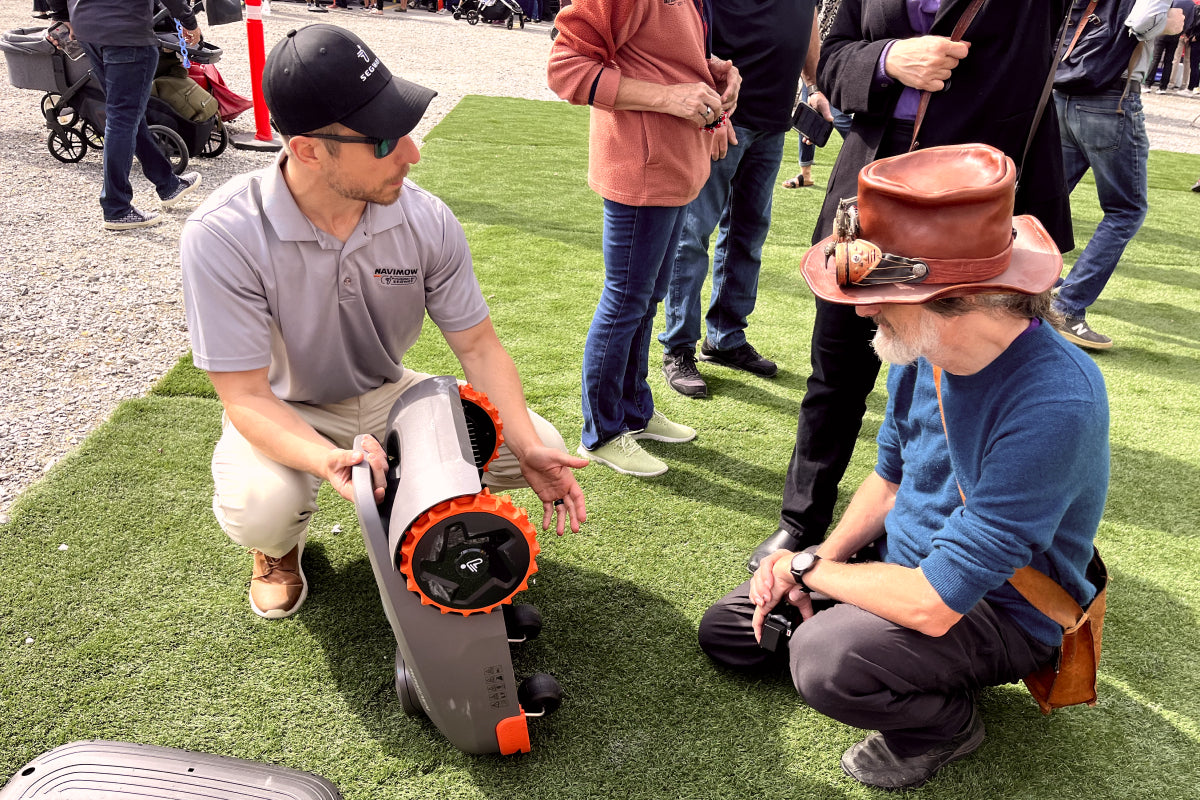
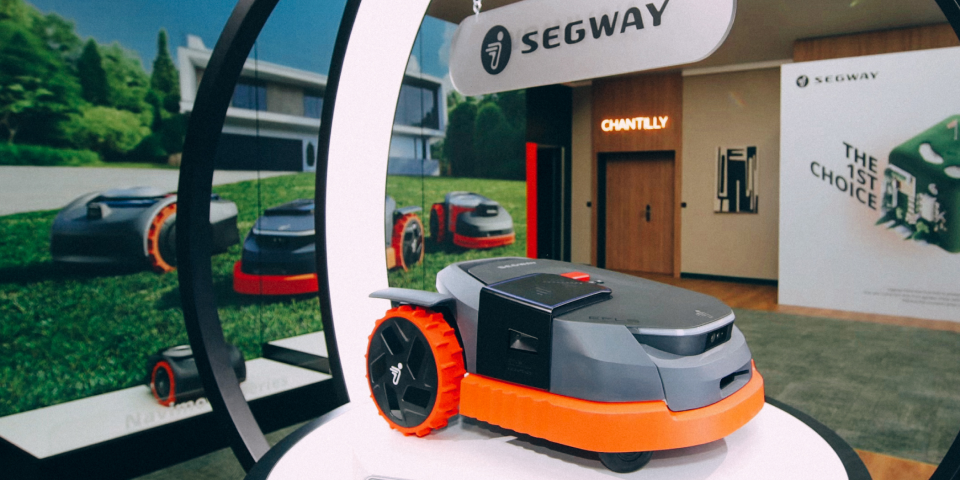
A robotic lawnmower with a grass catcher does indeed have another disadvantage: the large catcher impairs the mower's ability to reach and mow in narrow areas. For garden owners seeking maximum flexibility and automation, the Segway Navimow i105 and Segway Navimow i108 models are a reliable choice. Although they don't have a grass catcher, thanks to the improved EFLS 2.0 positioning technology, they mow efficiently and autonomously even on complex terrain. Compared to systems with a grass catcher, users benefit from lower maintenance costs and stable navigation without compromising mowing performance. Thanks to intelligent route planning and robust construction, the Navimow robots demonstrate that smart lawn care is possible even without a grass catcher – it's convenient, energy-efficient, and reliable.

Conclusion
Overall, robotic lawnmowers with grass catcher systems haven't yet become widespread due to considerations of weight, navigation, stability, and cost-effectiveness. Mulching remains the most practical solution for automated, energy-saving, and low-maintenance lawn care. However, future technologies could enable intelligent grass catcher solutions. Until then, the Segway Navimow robotic lawnmower offers a perfect combination of efficiency, precision, and user-friendliness – even without a grass catcher.

Dela: