


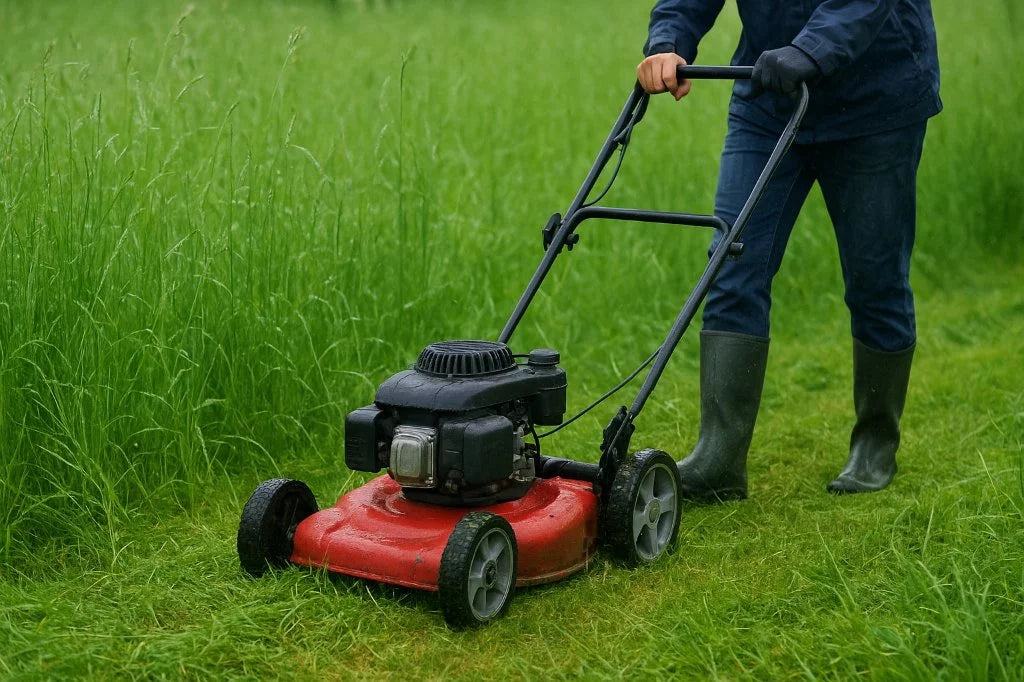
Mowing a lawn when the grass is long and wet is a real challenge: the blades of grass become longer, heavier, often flattened by the moisture or dew, and the soil can be waterlogged.
As a result, the mower may struggle, miss areas, leave stuck-on debris, or even damage the lawn or equipment. But in some cases, you can't wait until everything is perfectly dry: you have to take action.
This guide explains why it's tricky, when and how to do it correctly, and most importantly how your robotic lawnmower or manual mower (like those in the Navimow range) can be optimized for this situation.
Summary
Should you mow when the grass is wet?
As a general rule, it's best to wait until the grass is dry. Moisture causes several problems:
- The softened soil compacts under the wheels of the mower, leaving ruts or irregular windows.
- Wet blades of grass are often lying flat, do not stand upright, and the blade may miss them or tear them out rather than cut them cleanly.
- Damp grass accumulates under the housing or in the collection bin, causing frequent blockages.
- Finally, mowing under these conditions can weaken the lawn (torn blades, fungal diseases) and the tool itself.
That said: yes, you can mow wet grass if necessary — provided you take precautions and follow a suitable method.
So, the first step is to assess the condition—is the grass soaked or just wet? Is the ground muddy? If so, and if it can wait, it's best to postpone mowing. Otherwise, move on to preparation.
Preparations before mowing a tall, wet lawn
Proper preparation is essential for mowing tall, wet grass to go smoothly.
1. Choosing the right lawnmower
For tall, wet grass, opt for powerful equipment—a robust motor, good grass discharge, a large collection bag, or an efficient drainage system. For a standard manual mower, more power will be beneficial. For a robotic mower like Navimow, check that the model can handle challenging conditions (weather protocols, adjustable cutting height, automatic cleaning). Some guides suggest that a commercial (professional) mower will be better suited for extreme conditions.

2. Sharp blades and a collection bin
Make sure the blade is sharp: a dull blade will have more difficulty cutting wet grass cleanly and risks tearing it up. Prepare the grass catcher—or opt for a side discharge system—but be careful: mulching (shredding and returning grass clippings to the lawn) is not recommended on wet grass. Tall grass + wet grass + mulching = heavy accumulation, suffocating the lawn.
3. Height and speed adjustment
- Cutting height: Set the mower to a higher height than usual to avoid damaging the lawn. Tall grass, especially when wet, should not be cut too short all at once.
- Forward speed: Go slowly. Wet grass takes longer to cut cleanly. Too fast a speed results in an uneven cut.
- The "rule of thirds" method: If the grass is very high, don't cut it all at once. For example, on the first pass, cut 1/3 of the height, then come back a little later to refine the cut. This avoids stressing the lawn.
Step-by-step method for tall & wet grass
Here is a complete method for mowing a lawn with grass that is both tall and wet.
Step 1. Preliminary inspection and cleaning
Start by going over the surface to remove any large items: branches, stones, toys, debris. In tall grass, some objects may be hidden. Also, be careful to walk as little as possible on unmowed areas, as your steps could flatten the grass or create ruts.
Step 2. First high-altitude pass
Set the mower to its highest cutting height (e.g., 8-10 cm or more depending on the type of grass). Make a first pass slowly and systematically to shorten the grass without damaging it. The goal is to bring the tall grass down to a manageable height, rather than trying to cut it all at once. Many professionals recommend removing no more than a third of the height in this first pass.
Step 3. Waste collection
Next, make sure the grass clippings are properly collected (using a grass catcher) or disposed of correctly. On damp grass, do not leave the clippings in place: this can prevent air circulation and promote mold growth.
Step 4. Second pass at standard height
Once you've made the first pass, let it rest for a while (a few hours if possible) so the grass can recover. Then, make another pass at a "normal" height for your lawn. This final pass can be quicker, but always with caution: moderate speed, sharp blade.
Step 5. Cleaning after mowing
As soon as you finish mowing, clean your mower or robotic mower: under the deck, blades, wheels, and grass catcher. Damp grass sticks easily and can cause corrosion or malfunction. On robotic mowers, make sure the sensors are not obstructed.
Specifics for Navimow robotic lawnmowers
If you're using a robotic lawnmower like a Navimow model, be aware that long, wet grass requires extra precautions. Robots are generally designed for well-maintained lawns of moderate height and relatively dry soil. When the grass is very long or very wet, robots can struggle, sometimes resulting in blockages, erratic navigation, and a risk of slipping.

Recommended solution: Prepare the area before starting the robot. For example, mow manually or with the assist function (or switch to "cleaning" mode) to bring the grass down to an acceptable height. Then, let the robot take over for regular maintenance.
Adjust the robot settings:
- appropriate cutting height
- frequency + low speed,
- Avoid crossing immediately after or during rain, or on wet ground.
- Check that the work area is clear.
Some manufacturers explicitly advise against robotic mowing on wet grass because the blades do not grip well and the cut is uneven.
Pro tips & tricks for mowing tall, wet grass
Additional techniques to optimize mowing in critical conditions:
- Preventive lubrication: Coating the blade (with the machine off) with a vegetable-based lubricant (such as sunflower oil) reduces the adhesion of wet residues.
- Time management: Schedule the intervention after complete dissipation of the morning dew - a drying period of 2-3 hours improves cutting efficiency.
- Dynamic maintenance: Optimize the emptying frequency of the collection bin; humidity considerably increases the volumetric mass of plant waste.
- Work layering: For herbaceous layers exceeding 15 cm, anticipate by manual thinning or mechanical pre-cutting (brush cutter) before using the motorized mower.
Maintenance after mowing tall and wet grass
A few simple steps after mowing will ensure that your lawn and equipment remain in good condition:
- Clean your lawnmower/robot regularly: underside of the housing, blades, grass catcher, wheels. This prevents the accumulation of damp grass that could rot or clog the mechanisms.
- Check the blade: after mowing tall or wet grass, the blade may be dull or damaged — resharpen or replace it if necessary.
- On the lawn, observe if any areas are damaged, visible compactions: in this case, aerate the lawn or use a slightly perforating roller.
- If you have left any grass clippings, make sure they do not block the lawn's aeration: collect them or shred them very finely.

FAQs about mowing tall, wet grass
Here is a small table of common problems when mowing tall, wet grass, and how to deal with them.
| Issue | Probable cause | Quick solution |
|---|---|---|
| Uneven cut, frayed strands | Wet grass + dull blade | Sharpen the blade, wait until the grass is less wet. |
| Collection bin that fills up too quickly | Damp grass, high density | Empty frequently, do two passes rather than one drastic one. |
| Ground marked by wheels (ruts) | Soaked ground, heavy machinery | Avoid mowing while the ground is soft, or use a lighter machine/robotic mower. |
| Robot lawnmower that slips or gets stuck | Grass too high, soft soil | Lower the height manually, then start the robot and select the appropriate mode. |
| Lawn yellowed after mowing | Cut too low + wet grass | Raise the cutting height, lightly fertilize the lawn, avoid mulching on wet soil |
Conclusion
Mowing a lawn when the grass is long and wet isn't impossible, but it requires caution, good preparation, and well-thought-out steps. Remember: always start with a high cutting height, move slowly, use a sharp blade, empty the grass catcher more often, and if you're using a robotic mower like the Navimow range, make sure the lawn is prepared and the settings are correct.
If you're looking for a robotic lawnmower that can adapt to a variety of conditions—including higher or wetter areas—be sure to check out the Navimow range. With its intelligent settings, optimized grass catcher, and regular maintenance mode, it can truly make a difference in your lawn care routine.
Try it now and see how you can transform a difficult-to-manage lawn into a neat, healthy, and well-maintained one.

Share