


The quiet hum of the robotic lawnmower is a familiar and soothing sound for many garden owners – until suddenly it stops working. A broken lawnmower cable is not only annoying, but can also be a time-consuming and frustrating experience. Conventional search methods often involve digging up half the garden without pinpointing the exact location of the fault. But there is a more efficient solution: finding a broken lawnmower cable with a radio.
This technology revolutionizes troubleshooting, making it precise, time-saving, and gentle on your lawns. This comprehensive guide tells you everything you need to know about finding a broken cable on a robotic lawnmower using a radio. We explain how it works, introduce the necessary tools, and show you how to proceed step by step. We also present the Navimow i105, a robotic lawnmower that avoids the problem of broken cables altogether.
Contents
- Why is cable breakage such a common problem with robotic lawnmowers?
- Is it possible to locate a broken cable in a robotic lawnmower using a radio?
- Why “finding a robotic lawnmower cable break with a radio” is a good method
- Step-by-step instructions: How to find a broken cable on a robotic lawnmower using a radio
- Common problems when locating robotic lawnmower cable breaks using a radio
- The modern alternative: Avoid cable breakage with Navimow i105
- Conclusion
Why is cable breakage such a common problem with robotic lawnmowers?
Before we look at the solution, it's important to understand the causes. The boundary wire that defines the working area of your robotic lawnmower is exposed to various stresses. It often lies only a few centimeters underground and can be damaged by root growth, rodents, sharp garden tools, or even natural soil movement. Material aging and environmental factors such as frost also contribute to the problem.
The result: The robotic lawnmower detects the interruption in the signal and stops. A simple cable break thus paralyzes the entire automatic lawn care system. Manually searching for the break is often like the proverbial search for a needle in a haystack. This is precisely where the "Find Robotic Lawnmower Cable Break Using Radio" method comes in, offering a technological shortcut.

Is it possible to locate a broken cable in a robotic lawnmower using a radio?
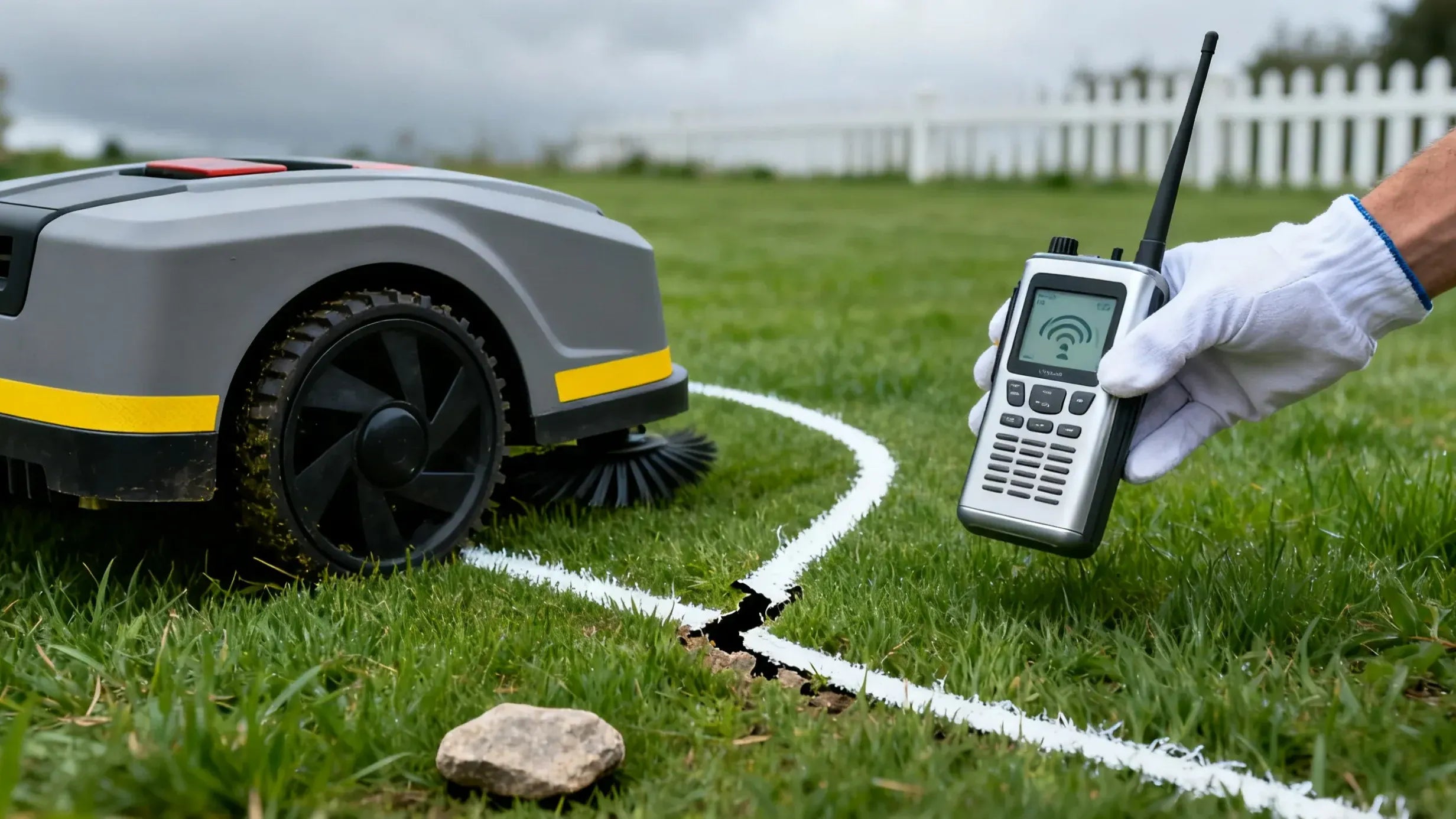
The method of locating a broken lawnmower cable using radio signals may sound technical at first, but it is an established and user-friendly procedure. Essentially, it involves inductive cable locating. A special radio signal (a low-frequency alternating current) is fed into the boundary wire.
This is done using a cable locator, which consists of a transmitter and a receiver. The transmitter is connected to the cable and sends out the signal. The damaged cable radiates this signal along its entire length to the point of breakage. Using the receiver, a type of antenna, you can follow this signal along the suspected cable path. The crucial observation when locating a broken cable on a robotic lawnmower using a radio signal is that the signal ends abruptly at the point of the break. At precisely this point, the line is interrupted, and the signal can no longer travel.
This technique of finding a broken lawnmower cable using a radio is not only relevant for lawnmowers, but has been used for decades by professional electricians and construction workers to locate underground cables.

Why “finding a robotic lawnmower cable break with a radio” is a good method
Choosing to locate a broken cable on your robotic lawnmower using a radio offers several compelling advantages over other methods:
- Wide applicability: Since this method is based on the low-frequency signal generated by the boundary wire current and not on manufacturer-specific protocols, it can be used to test virtually all lawnmower brands.
- Time efficiency: What used to take hours or even days can now be done in minutes with this method. Troubleshooting is dramatically accelerated.
- Gentle on the lawn: Since you only need to dig in a very small area, your garden remains largely undamaged. The visual damage is minimal.
- Cost-effectiveness: Although you have to invest in a cable locator, you will save money in the long run because you can avoid expensive repair services or the complete replacement of the cable.
- Easy to use: Modern devices are user-friendly and do not require extensive technical knowledge.
Compared to the frustrating search using trial and error, the decision to try to find the robotic lawnmower with radio and cable break is a real quantum leap for every owner of a robotic lawnmower.
Step-by-step instructions: How to find a broken cable on a robotic lawnmower using a radio
Requirements for implementation
Before you begin, you should ensure that the following conditions are met so that the robotic lawnmower cable break with radio can work efficiently:
- Your charging station is correctly connected, the boundary wire is active and powered.
- You have an AM or medium wave radio at hand, ideally with volume control, which you can tune to a frequency without station reception (e.g. in the range 526.5 … 700 kHz).
- The route of the boundary wire should be known as far as possible – laid under lawn, lawn edge, paving or freely in the ground.
- Unnecessary electrical interference (e.g., garden lighting, large metal parts) was avoided as much as possible or at least taken into account, as it can distort the noise.
- Patience: For longer cable runs or complex garden layouts, the search may take some time.
Step 1 – Preparation
Please disconnect all additional cables from the charging station, except for the boundary wire, to avoid false signals or damage. Many errors are caused by the station or the power supply, not just the cable itself.
Tune the radio: Find a frequency without regular station reception (e.g., an "empty" band between radio stations).
If possible, mark the cable entry point (e.g., at the charging station). Then start your "wireless readout".

Step 2 – Guide the radio along the cable
Walk along the known path of the boundary wire, keeping the radio close to the ground. Hold the radio so you can clearly hear the hum or hiss. In many cases, a user writes in the forum: "I easily located a broken wire using an old radio tuned to longwave. ... It only took me 3 minutes." As you walk along the boundary wire, you will hear:
- Constant noise - cable intact
- The noise suddenly becomes quieter or stops – possible location of a broken lawnmower cable.

Step 3 – Mark the break point
As soon as the noise disappears or is noticeably reduced, mark this spot in the ground – e.g. with a small planting stick, tuft of grass or marking spray.
Walk back and forth to make sure the signal actually ends at that point – sometimes the point can be slightly off (e.g. due to ground contours or cable depth).

Step 4 – Expose and prepare for repair
Dig carefully at the marked spot – avoid further damage from improper digging. Visually inspect the boundary wire: is it cut, damaged, or corroded?
If the cable is indeed defective, carry out a repair – for example, with a cable connector, replacement piece, or suitable connection material. Tutorials recommend regular cable maintenance and proper connection points.

Step 5 – Function test
Carefully reattach the cable and connect everything according to the manufacturer's instructions. Switch on the charging station and check:
- Is the control LED lit green or in normal operating mode?
- Will the robotic lawnmower recognize the loop signal again?
- Does it start and return to the station as usual?
If yes: Problem solved. If no: The fault may lie deeper (e.g., power supply, circuit board, probe cable, etc.).

Common problems when locating robotic lawnmower cable breaks using a radio
- Impatience: Some garden sections are long, winding, or difficult to access – plan your time!
- Concealed cable routing: Cables under paving stones, old lawns or lawn edges can reduce noise – check more frequently if necessary.
- Connections as weak points: Connectors, transitions or vole activity – these are often sources of error.
- Charging station malfunction: If the charging station or power supply fails, radio methods will prove largely ineffective – therefore, first check the base station and the connections.
- Don't underestimate sources of interference: Metal parts or power lines near the boundary wire can distort the signal – check your surroundings.
The modern alternative: Avoid cable breakage with Navimow i105
While using a radio to locate a broken cable on a robotic lawnmower is an excellent repair tool, the question arises: Is there a solution that completely avoids the problem of a broken cable? The answer is a clear yes.
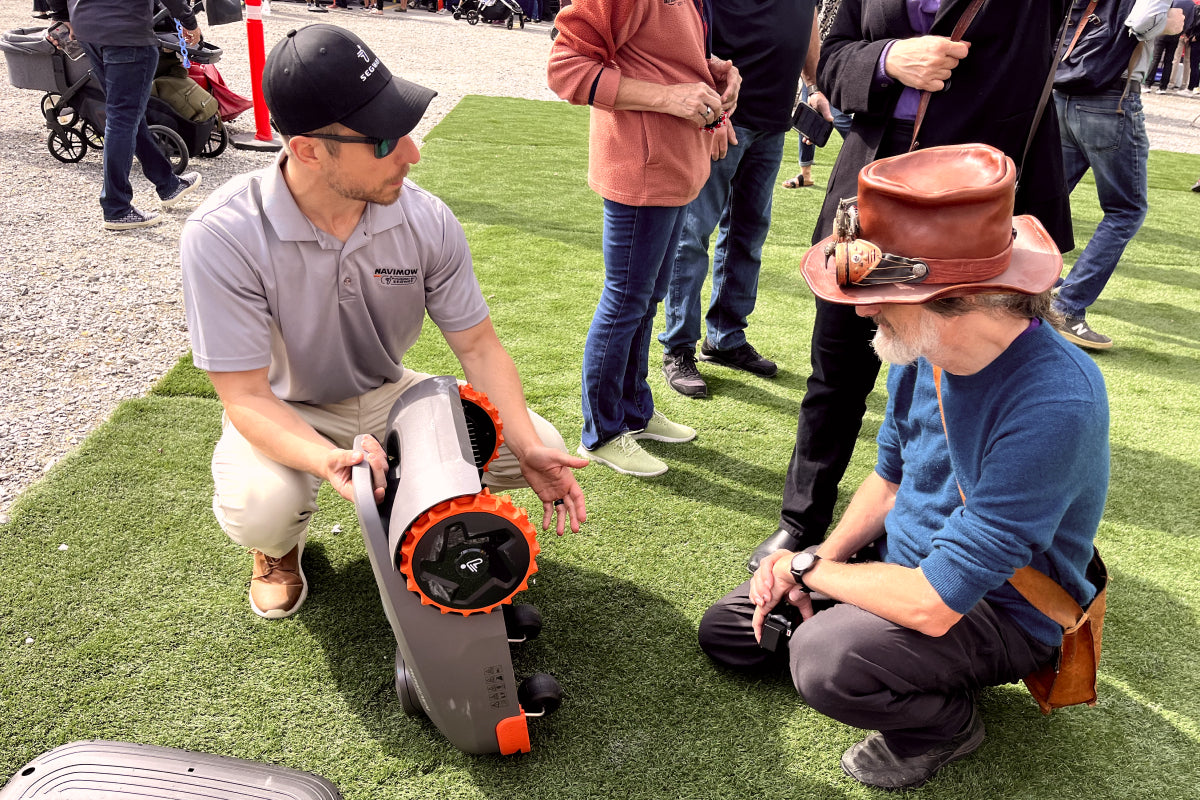
We recommend the Segway Navimow i105 robotic lawnmower. This innovative robot eliminates the need for the cumbersome and interference-prone boundary wire. Instead, it navigates precisely through your garden using GPS satellite signals. A prior digital mapping of your property defines the mowing zones, between which the Navimow i105 then moves freely and without physical boundaries.

Advantages of the Navimow i105 at a glance:
- No need to lay boundary wires: Save yourself the initial installation and all associated future repairs.
- No more broken cables: The problem you no longer have to search for is a solved problem. You'll never again have to deal with a broken cable on your robotic lawnmower with a radio.
- Maximum precision: GPS navigation ensures clean and complete mowing, even in complex gardens.
- Easy zone division: You can easily define mowing and exclusion zones via the app.
- Theft protection: Thanks to GPS tracking, you can monitor the location of your robotic lawnmower at any time in the app.
So if you are looking for a good solution for both sides – namely troubleshooting today and less effort tomorrow – then take a closer look at the Navimow i105.
Conclusion
A broken lawnmower cable no longer has to be a nightmare. Using a radio to locate a broken cable is by far the most efficient and gentle way to fix the problem. It saves time, frustration, and your beautiful lawn. Invest in a high-quality cable locator, and you'll be perfectly prepared for such incidents.
Even better, however, is to eliminate the problem altogether. Modern technologies like the Segway robotic lawnmower make the annoying boundary wire and its associated breaks obsolete. Regardless of which path you choose – whether you opt for a robotic lawnmower with a built-in radio to detect cable breaks or switch directly to a wireless system – you'll gain valuable time that you can then enjoy in your perfectly mowed garden. Ultimately, the ability to detect cable breaks on a robotic lawnmower with a built-in radio is invaluable. However, the Segway Navimow i-series models, such as the i105, represent an even more advanced solution for worry-free lawn care.

Share